How to Read Your Saju (Four Pillars) in English — A Beginner's Walkthrough
Learn how to read your Saju (Four Pillars of Destiny) in plain English. A step-by-step beginner's walkthrough: find your Day Master, the Five Elements, and what your chart means — plus where to get a free Saju reading.
You've heard that Saju — Korea's "Four Pillars of Destiny" — is more personal than a horoscope sign, and you're curious what your chart actually says. The problem: almost every good explainer is in Korean, and the English ones jump straight to hanja tables that look like a chemistry exam.
This walkthrough fixes that. We'll go step by step, in plain English, so by the end you'll understand the four pieces of your own Saju chart and what they mean — no prior knowledge needed. And if you'd rather skip the manual math, there's a free Saju reading option at the end that builds your chart for you.
(One honest frame first: Saju is a tool for reflection and self-understanding — entertainment and insight, not medical, legal, or financial advice. Read it as a mirror, not a forecast.)

Step 0: What you need before you start
Saju reads four moments of your birth, so you need:
- Your birth date (year, month, day)
- Your birth time — ideally to the hour. This matters more than in Western astrology; the hour is a full pillar.
- Your birth place (for time-zone and true-local-time adjustments)
Don't know your exact birth time? You can still read three of the four pillars — just know the hour pillar (your inner/private layer) will be missing.
Step 1: Understand what the Four Pillars are
"Saju" (사주, 四柱) literally means "four pillars." Each pillar is one unit of your birth time:
- Year pillar → your roots and the broad backdrop of your life
- Month pillar → your environment, ambition, and how you engage the world
- Day pillar → you (the most important pillar)
- Hour pillar → your inner world and later life
Each pillar holds two characters: a Heavenly Stem (천간 / 天干) on top and an Earthly Branch (지지 / 地支) below. Four pillars × two = eight characters — which is why the Chinese name for the same system is Bazi, "eight characters."
Step 2: Find your Day Master (this is "you")
Here's the single most useful move for a beginner: find your Day Master. Your Day Master is the Heavenly Stem of your Day pillar, and it represents you — as one of the Five Elements.
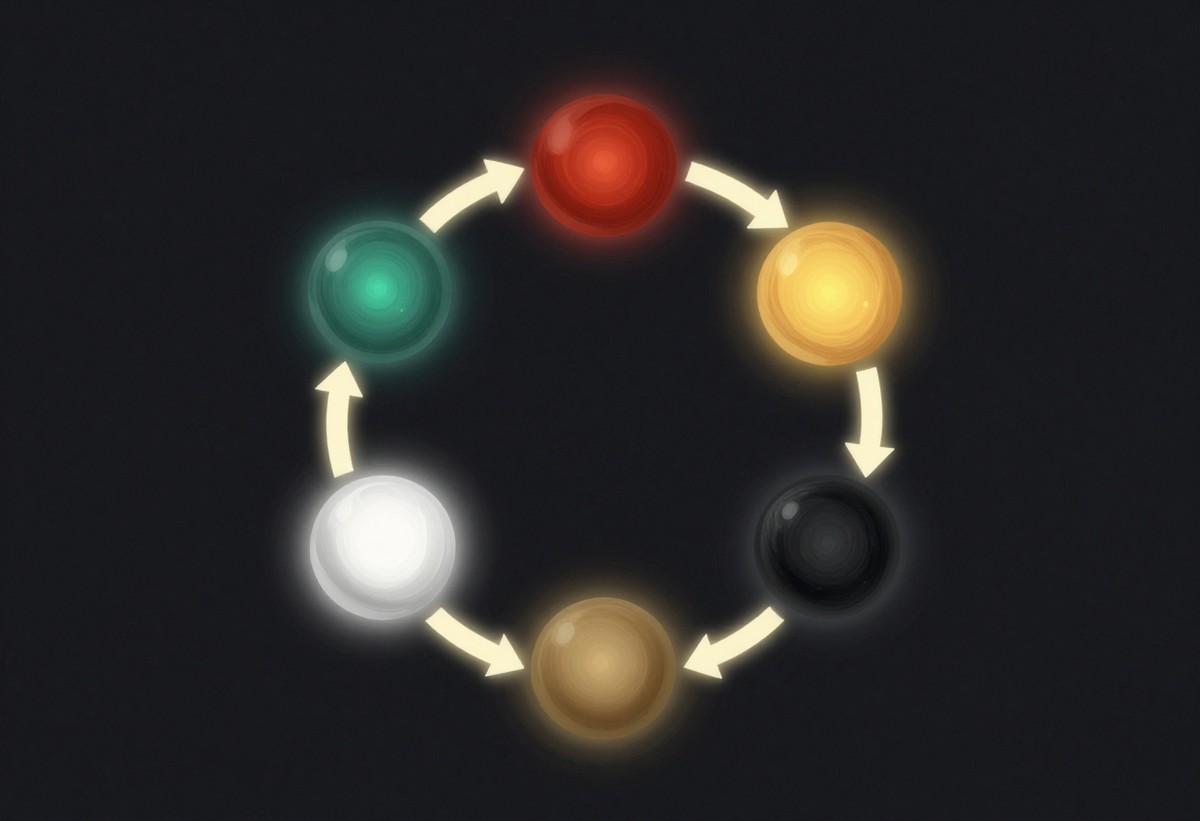
The Five Elements (오행 / 五行) are:
- Wood (목/木) — growth, vision, kindness, expansion
- Fire (화/火) — energy, passion, visibility, warmth
- Earth (토/土) — stability, trust, grounding, patience
- Metal (금/金) — structure, clarity, discipline, justice
- Water (수/水) — wisdom, adaptability, intuition, flow
Whichever element your Day Master is, that's your core. A Wood Day Master is a fundamentally different starting self from a Water Day Master — and the rest of the chart is read in relation to it.
Step 3: Read the balance, not just the labels
Beginners often stop at "I'm a Fire Day Master" — but the real insight is balance. Saju looks at all eight characters and asks: which elements are abundant, which are missing, and how do they support or drain your Day Master?
A few plain-English examples of what balance reveals:
- A lot of your supporting element → you tend to feel resourced, backed-up, steady.
- A lot of what your element produces → you give out energy, express, create — sometimes to depletion.
- A missing element → an area you may keep reaching for, or a quality you actively grow into over life.
You don't need to memorize the cycles to feel the point: your chart isn't a single label, it's a weather system of elements around your core self. That's why two people with the same Day Master can read very differently.
Step 4: Add the time layer (luck pillars)
Saju isn't only a static portrait — it also describes how your energies shift over time through "luck pillars" (대운), roughly ten-year chapters that change which elements are emphasized in your life. This is the part that makes Saju feel less like a fixed label and more like a map of seasons. For a beginner, the takeaway is simple: a "challenging" element showing up isn't doom — it's a theme to work with during that chapter.
Step 5: Put it together (a mini example)
Imagine a chart with a Fire Day Master, lots of Wood, and very little Water.
- Fire = you: expressive, warm, drawn to visibility.
- Lots of Wood: Wood feeds Fire, so you're well-supplied with fuel — ideas, drive, momentum. You rarely lack motivation.
- Little Water: Water tempers Fire, so cooling-down, rest, and reflection may be the deliberate skill you build over time.
Notice how nothing here is "good luck / bad luck." It's a description you can use — lean on your momentum, build in your rest. That's Saju read as self-reflection.
The honest shortcut: get your chart built for you
Doing this by hand means converting your birth time to true solar time, mapping stems and branches from a 60-cycle calendar, and assigning elements — accurate, but tedious for a first read. If you'd rather just see your chart and start with the interpretation, that's exactly the friction we built k-saju.me to remove.
Enter your birth date, time, and place, and it builds your Four Pillars (Saju) chart and explains it in plain English — your Day Master, your Five-Element balance, and how your energies are arranged. You can get a free Saju reading with no credit card, so you can see your own chart and decide for yourself whether it resonates.
If you want to keep going, a single in-depth Four Pillars report is $4.99, or the $7.99/month plan comes with a 7-day free trial — a daily Saju card, a deeper premium reading, and tracking of how your energies shift over time. Cancel anytime.
→ Get your free Saju reading in English — no card needed
Saju is offered here for entertainment and self-reflection — a lens for understanding yourself, not a replacement for professional medical, legal, or financial advice.